Author: waivs

  • 24/7 Patient Messaging Is Not the Same as 24/7 Clinical Coverage 

    24/7 Patient Messaging Is Not the Same as 24/7 Clinical Coverage 

    Patients can need guidance outside office hours. Giving them a channel that is always available is valuable, but what does availability mean in the context of AI? 

    Patient Messaging Availability vs. Clinical Coverage 

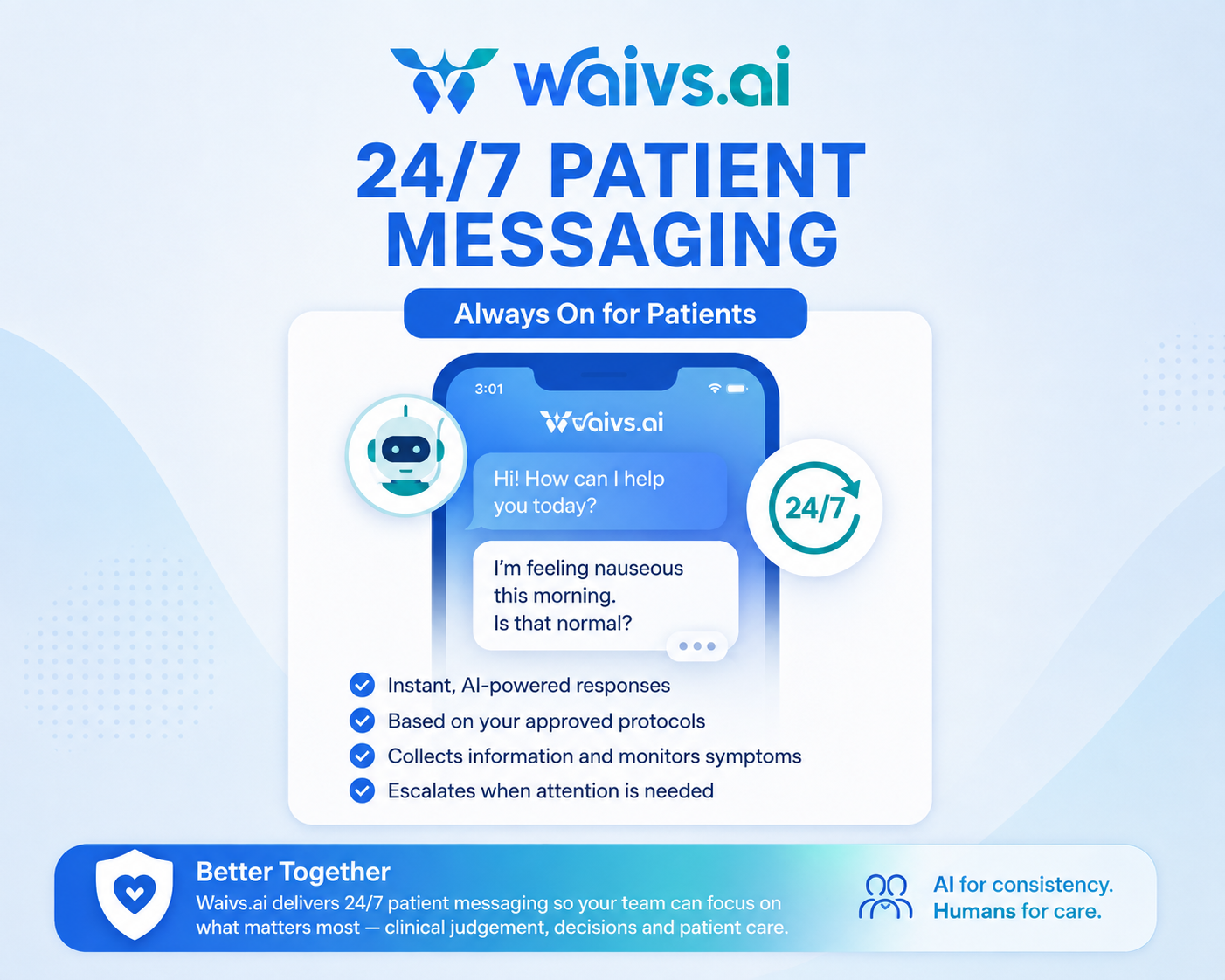
    24/7 patient messaging means a patient can send a message or respond to an automated check-in at any time. The system can receive the interaction, provide approved routine information within its configured boundaries and collect patient-reported details for the program. 

    24/7 clinical coverage means a qualified clinical professional is continuously available to assess the information and respond. These are different operating models. A website or patient communication should not imply the second simply because the technology supports the first. 

    The distinction is especially important after surgery, when a patient may interpret phrases such as “always available” or “real-time support” as a promise that a clinician is watching every interaction immediately. 

    What 24/7 Patient Messaging Availability Can Accomplish 

    An AI Surgical Care Companion can support routine, program-approved interactions outside office hours. A patient may ask about an education topic, complete a scheduled check-in or report information that the program wants to collect consistently. 

    The system can document the interaction and identify responses matching predefined escalation criteria. That creates a structured record for the team and can support earlier visibility than waiting for the patient to call during business hours. 

    The technology can also explain that it does not provide emergency care and that clinical review follows the program’s defined workflow. The specific emergency and after-hours instructions provided to patients should be approved by the program and should not promise capabilities that are not operationally available. 

    What Is a Surgical Programs Role in Curating a Patient Engagement Program 

    Technology does not decide the staffing model. Before launching 24/7 messaging, the program should define who reviews escalated interactions, when queues are monitored, which notifications are sent, what response windows apply and how responsibility changes outside normal hours. 

    The program should also decide which questions may receive an automated response and which should always go to human review. A patient’s procedure type, stage of care, days since surgery and previous responses may affect the applicable workflow, but those variables do not replace clinical interpretation. 

    Finally, the patient-facing language should be tested. Patients need to understand what the system can answer, when a person will review a message and what the system is not designed to do. 

    Recommended Wording When Explaining the Availability Accessible to Them 

    Stronger wording is specific: “Patients can send messages to the Waivs Surgical Care Companion 24 hours a day. Waivs can provide approved routine guidance and collect information at any time. Clinical review and response timing follow your program’s staffing and escalation procedures.” 

    Avoid language such as “a clinician is always available,” “immediate clinical response” or “24/7 medical monitoring” unless those statements are operationally true, contractually supported and consistently delivered. 

    Accuracy in this language is not a limitation. It is part of responsible patient communication and establishes clearer expectations for both the patient and the care team. 

    A Sample of an After-hours Interaction 

    A patient sends a message in the evening. The companion determines the relevant approved workflow using the patient’s procedure, stage, and timing. If the question is covered by approved program content, it provides that information and records the interaction. If the response matches a predefined escalation criterion or is outside the approved content, it is surfaced for human review according to the program’s configured process. 

    The patient does not need to wait until the office opens to submit the information. At the same time, the system does not imply that a clinician has already evaluated it. That is the practical value of 24/7 messaging when expectations are designed responsibly. 

    Availability should be designed as a service model 

    The question is not only whether patients can message at any time. It is whether the program has defined what happens next. Map patient expectations, automated boundaries, escalation ownership and response timing together before describing the service as 24/7. 

    Sources and further reading 

    1. College of Physicians and Surgeons of Ontario. Using Artificial Intelligence in Clinical Practice. Updated August 2025. https://www.cpso.on.ca/Physicians/Policies-Guidance/Advice-to-the-Profession/Using-Artificial-Intelligence-in-Clinical-Practice 
    1. National Institute of Standards and Technology. Artificial Intelligence Risk Management Framework (AI RMF 1.0). NIST AI 100-1. 2023. https://www.nist.gov/publications/artificial-intelligence-risk-management-framework-ai-rmf-10 
  • How AI Fits into a Surgical Workflow – Save Coordinators Time for Patients Who Need It 

    How AI Fits into a Surgical Workflow – Save Coordinators Time for Patients Who Need It 

    The value of AI in a surgical workflow is not that it replaces judgment. It is that it separates repeatable communication from work that requires a clinician or coordinator. 

    Patient Competition for Attention in your Inbox – High and Low Priority 

    A patient asking which diet stage comes next and a patient describing a possible warning sign may reach the clinic through the same phone line or message queue. One request may be answered using standard program guidance. The other may require rapid review, context and clinical judgment. Until someone reads both, they compete for the same attention. 

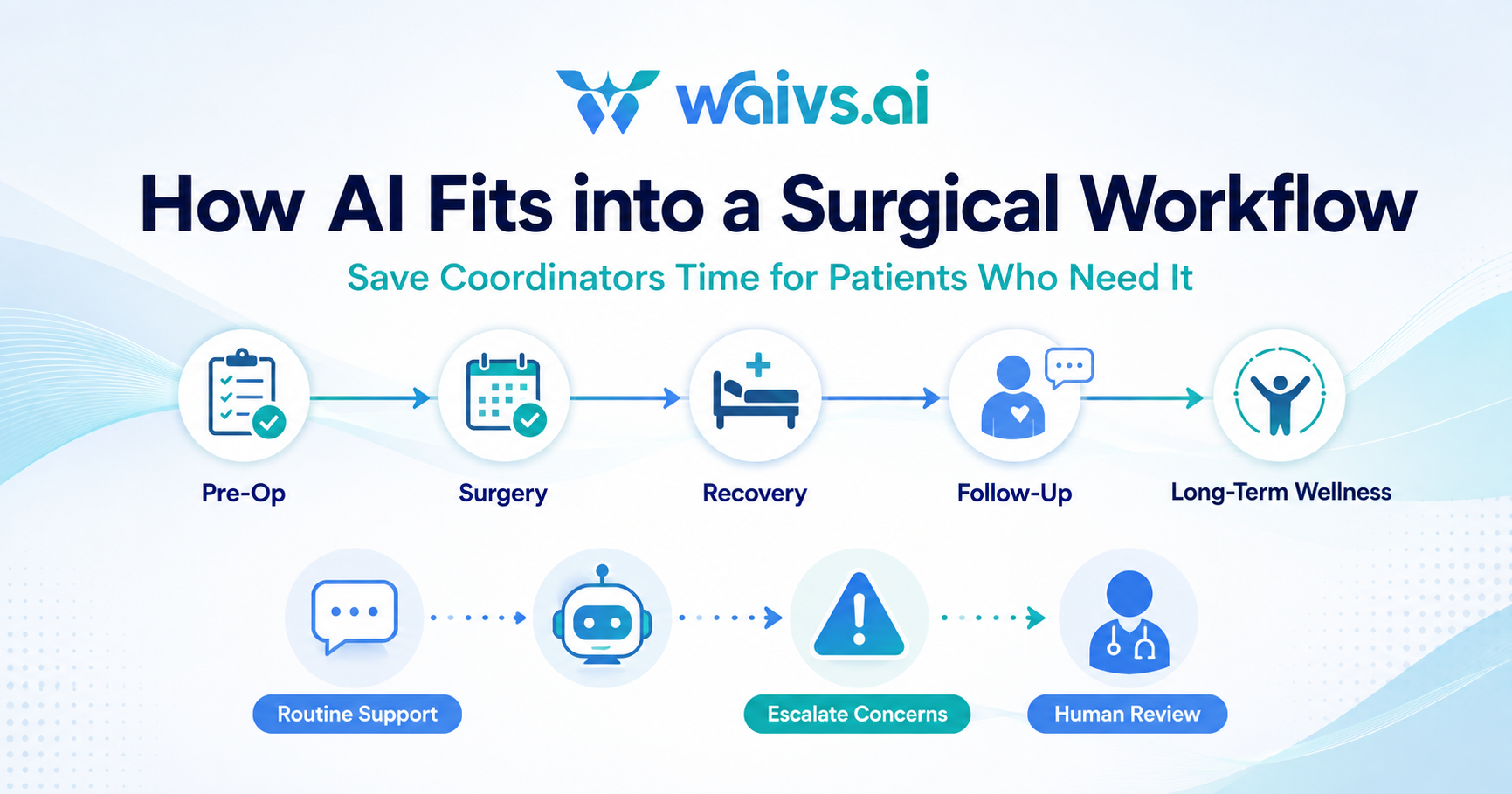
    This is where an AI Surgical Care Companion can fit into the workflow. Its role is not to make independent clinical decisions. Its role is to support routine communication, collect structured patient information and identify responses that match the program’s predefined escalation criteria. 

    CPSO guidance on AI in clinical practice emphasizes that AI should complement care rather than replace medical expertise. It also highlights accuracy, accountability, privacy, bias, transparency and clinician review as important considerations. [4] 

    What the AI can support 

    A surgical program can use the companion for repeatable tasks such as preoperative reminders, readiness questions, education reinforcement, postoperative check-ins, appointment prompts and common questions that are answered by approved program content. 

    The customer uploads its own protocols, care guide and internal templates. Those materials define the boundaries of the patient experience. The system should not invent a new clinical pathway or substitute generic internet content for the program’s instructions. 

    The program can configure different workflows by procedure type and stage of care. Context can include whether the patient is pre-op or post-op, the number of days since surgery and previous responses. These factors can determine which approved questions are asked and which escalation criteria apply. 

    What does the AI not do 

    The companion should not diagnose a complication, select a treatment, override a clinician or provide an unapproved answer simply because the patient asked a question. When an interaction falls outside approved content or the system is uncertain, the safer workflow is to stop, document the interaction and route it for human review. 

    It is also important to distinguish a predefined escalation match from a clinical judgment. The system can identify that a response meets a condition configured by the program. A qualified member of the care team decides what the response means and what action is appropriate. 

    Clear language protects both patients and staff: Waivs organizes and surfaces information; clinicians interpret and act on it. 

    A simple message-handling workflow 

    A practical workflow has five stages. First, the patient sends a message or responds to a check-in. Second, the system uses the relevant procedure, stage, timing and previous responses to select the appropriate approved workflow. Third, routine questions are answered using customer-provided content. Fourth, responses matching predefined escalation criteria are surfaced to the appropriate role. Fifth, the clinician, nurse, coordinator or other authorized team member reviews the information and decides the next step. 

    Administrator-controlled permissions determine who can view transcripts, patient responses, escalation details and other administrative information. Surgeons, nurses, coordinators and dietitians may need different access based on their responsibilities. 

    This model keeps human accountability visible. The AI supports the flow of information without becoming the final decision-maker. 

    Where to begin 

    Start with one workflow that is routine, frequent and already guided by a stable protocol. A postoperative check-in, preoperative checklist reminder or common education question is usually easier to govern than a broad, open-ended clinical interaction. 

    Document the approved source material, the information the system may collect, the escalation conditions, the responsible reviewer and the expected response window. Test routine, ambiguous and concerning scenarios before using the workflow with patients. 

    The best first use case is not necessarily the one with the biggest theoretical return. It is the one the program can define, supervise and measure clearly. 

    AI should create a clearer queue—not a hidden one 

    A useful implementation makes it easier to see what was answered, what was escalated, why it was escalated and who is responsible for review. If the workflow is not understandable to the people operating it, automation has only moved the complexity somewhere else. 

    Sources and further reading 

    1. College of Physicians and Surgeons of Ontario. Using Artificial Intelligence in Clinical Practice. Updated August 2025. https://www.cpso.on.ca/Physicians/Policies-Guidance/Advice-to-the-Profession/Using-Artificial-Intelligence-in-Clinical-Practice 
    1. National Institute of Standards and Technology. Artificial Intelligence Risk Management Framework (AI RMF 1.0). NIST AI 100-1. 2023. https://www.nist.gov/publications/artificial-intelligence-risk-management-framework-ai-rmf-10 
  • How Does Human-in-the-Loop AI Work in Surgical Patient Care? 

    How Does Human-in-the-Loop AI Work in Surgical Patient Care? 

    Human-in-the-loop is not a single approval button. It is an operating model that defines what the AI may do, what it must not do and where people remain accountable. 

    Human oversight begins before the first patient message 

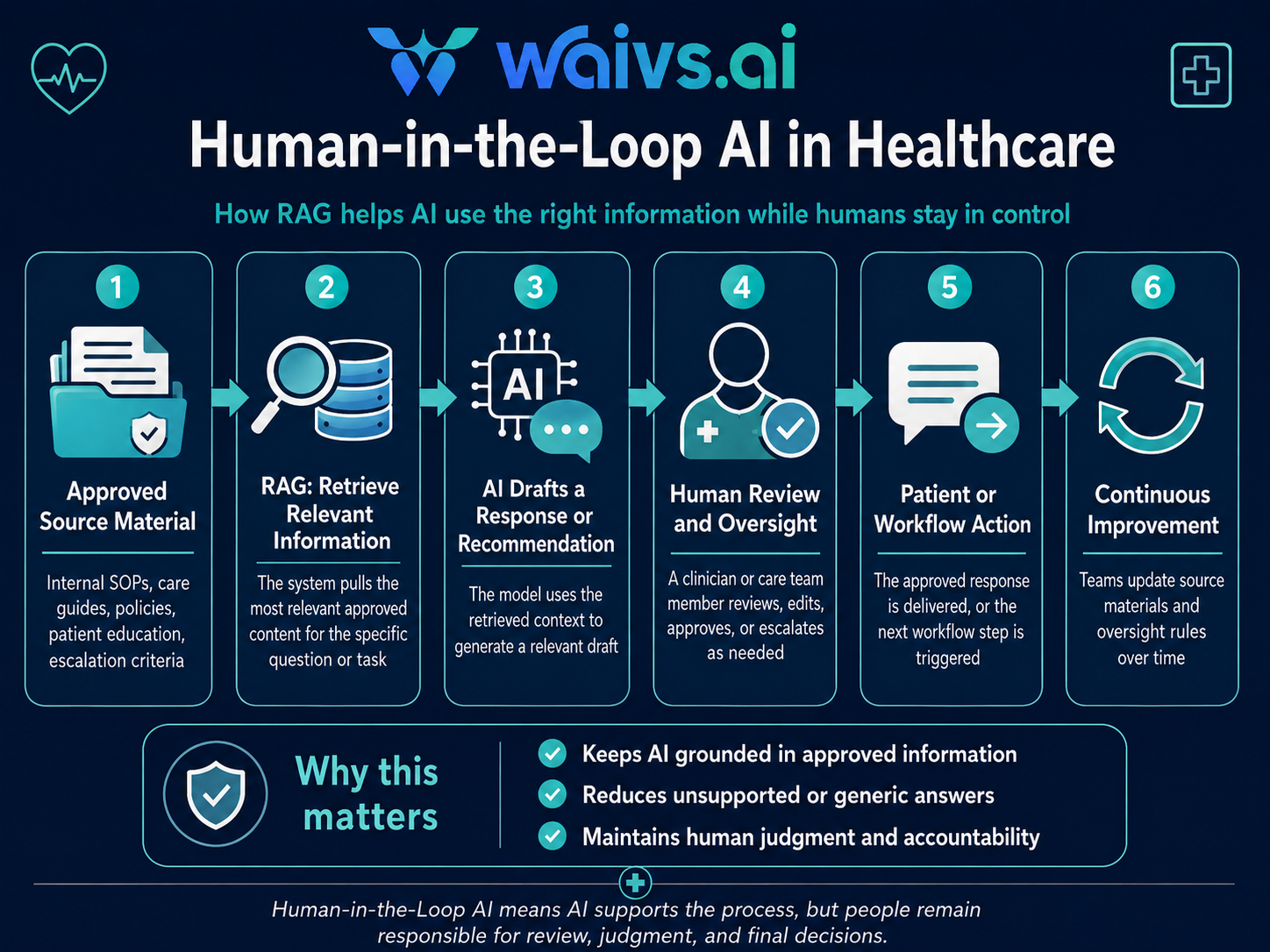
    A responsible AI workflow is designed by people before it is used by patients. The surgical program decides which use cases are appropriate, which content is approved, what information may be collected, which escalation criteria apply and who is responsible for review. 

    NIST’s AI Risk Management Framework describes AI risk management as an ongoing organizational process rather than a one-time technical checklist. The framework emphasizes governance, context, measurement and risk management across the AI lifecycle. [5] 

    For a patient-facing surgical companion, that means human oversight must exist in the knowledge sources, workflow design, access controls, review process and ongoing monitoring. 

    Layer 1: Program-approved knowledge boundaries 

    The customer uploads its own surgical protocols, care guide and internal templates. These materials define the information Waivs may use for routine patient communication. An approved knowledge boundary is more useful than a broad promise that the AI “knows surgery.” 

    Clinical leaders should review the source materials before implementation and approve changes before updated content becomes active. Outdated, contradictory or incomplete materials should be resolved rather than passed directly into an automated workflow. 

    When a patient asks a question outside the approved content, the system should not improvise a clinical answer. It should identify the boundary and move the interaction to human review. 

    Layer 2: Context without autonomous judgment 

    A surgical workflow can use context such as procedure type, pre-op or post-op stage, days since surgery and previous responses. These variables help select the relevant approved questions, education and escalation criteria. 

    Context is not the same as diagnosis. The AI may determine which configured workflow applies, but a clinician interprets the patient’s condition and makes treatment decisions. CPSO guidance similarly states that AI is intended to complement clinical care and that physicians remain accountable for its use. [4] 

    This distinction should be visible in patient and staff materials: the system identifies matches and organizes information; the care team makes clinical judgments. 

    Layer 3: Predefined escalation criteria 

    The program defines the responses, patterns or conditions that should prompt review. Different criteria may apply by procedure, stage or recovery timing. The system identifies when a patient response matches those predefined criteria and surfaces the interaction to the appropriate team member. 

    An escalation is not a diagnosis and should not be described as one. It is a workflow signal that tells the program a human should review the information. 

    Teams should test the criteria against routine, ambiguous, incomplete and concerning scenarios. They should also review false positives, missed matches and changes in clinical protocols over time. 

    Layer 4: Role-based permissions and accountable review 

    Administrators determine who can see which information on the administrative side. Surgeons, nurses, coordinators, dietitians and other team members may receive different access based on their responsibilities. 

    Permission design should follow the minimum necessary principle: people should have the access required to perform their role without exposing information unnecessarily. Privacy and security risk analysis should consider how data are created, accessed, transmitted, storedand reviewed. HHS describes risk analysis as foundational to selecting safeguards for electronic protected health information. [6] 

    The implementation should make ownership explicit. Every escalated workflow needs a responsible role, an expected review process and a way to audit what happened. 

    What happens when the AI is uncertain? 

    Uncertainty is not a failure if the workflow is designed to handle it. The safer response is to remain within approved content, avoid an unsupported answer and route the interaction for human review. 

    Programs should test how the system responds to vague wording, multiple concerns in one message, contradictory answers, missing information and requests that fall outside the companion’s purpose. 

    A trustworthy implementation does not claim that hallucinations or errors are impossible. It creates controls that reduce risk, expose uncertainty and keep people responsible for the final decision. 

    Questions leaders should ask before launch 

    Which protocols and templates are approved for patient use? Who can change them? What context determines the workflow? Which responses trigger review? What happens when the answer is uncertain? Who can see the interaction? Who owns the escalation queue? How are changes tested? How will the program review performance and incidents? 

    These questions turn “human-in-the-loop” from a marketing phrase into an operating model. If the answers are unclear, the program is not ready to scale the workflow. 

    The core principle 

    AI can extend the reach of approved communication and make patient-reported information easier to organize. It should not transfer clinical accountability away from the surgeon or care team. The strongest implementation is one in which the boundaries, escalation logic and human responsibilities are understandable to everyone using it. 

    Sources and further reading 

    1. College of Physicians and Surgeons of Ontario. Using Artificial Intelligence in Clinical Practice. Updated August 2025. https://www.cpso.on.ca/Physicians/Policies-Guidance/Advice-to-the-Profession/Using-Artificial-Intelligence-in-Clinical-Practice 
    1. National Institute of Standards and Technology. Artificial Intelligence Risk Management Framework (AI RMF 1.0). NIST AI 100-1. 2023. https://www.nist.gov/publications/artificial-intelligence-risk-management-framework-ai-rmf-10 
    1. U.S. Department of Health and Human Services, Office for Civil Rights. Guidance on Risk Analysis under the HIPAA Security Rule. https://www.hhs.gov/hipaa/for-professionals/security/guidance/guidance-risk-analysis/index.html 

  • Three Places Bariatric Patients Disengage Before and After Surgery 

    Three Places Bariatric Patients Disengage Before and After Surgery 

    Patient disengagement is common across surgical practices. It usually develops through small missed steps, unanswered questions and fading contact across a long bariatric care journey that can feel overwhelming to patients. 

    Patient leakage is usually a pathway problem, not a single missed call 

    Bariatric programs often use the term patient leakage to describe patients who stop progressing, disengage from follow-up or leave the care pathway. The term can sound financial, but the underlying problem is operational and human: patients encounter delays, uncertainty, competing priorities, complex requirements and major behaviour changes over an extended period. 

    A 2026 narrative review found wide variation in bariatric surgery completion rates across programs and countries. The review identified waiting times, insurance barriers, psychosocial readiness, motivation and program design among the factors associated with preoperative attrition. That variability matters because it shows there is no single reason patients disappear from a pathway and no single reminder that will solve every case. [2] 

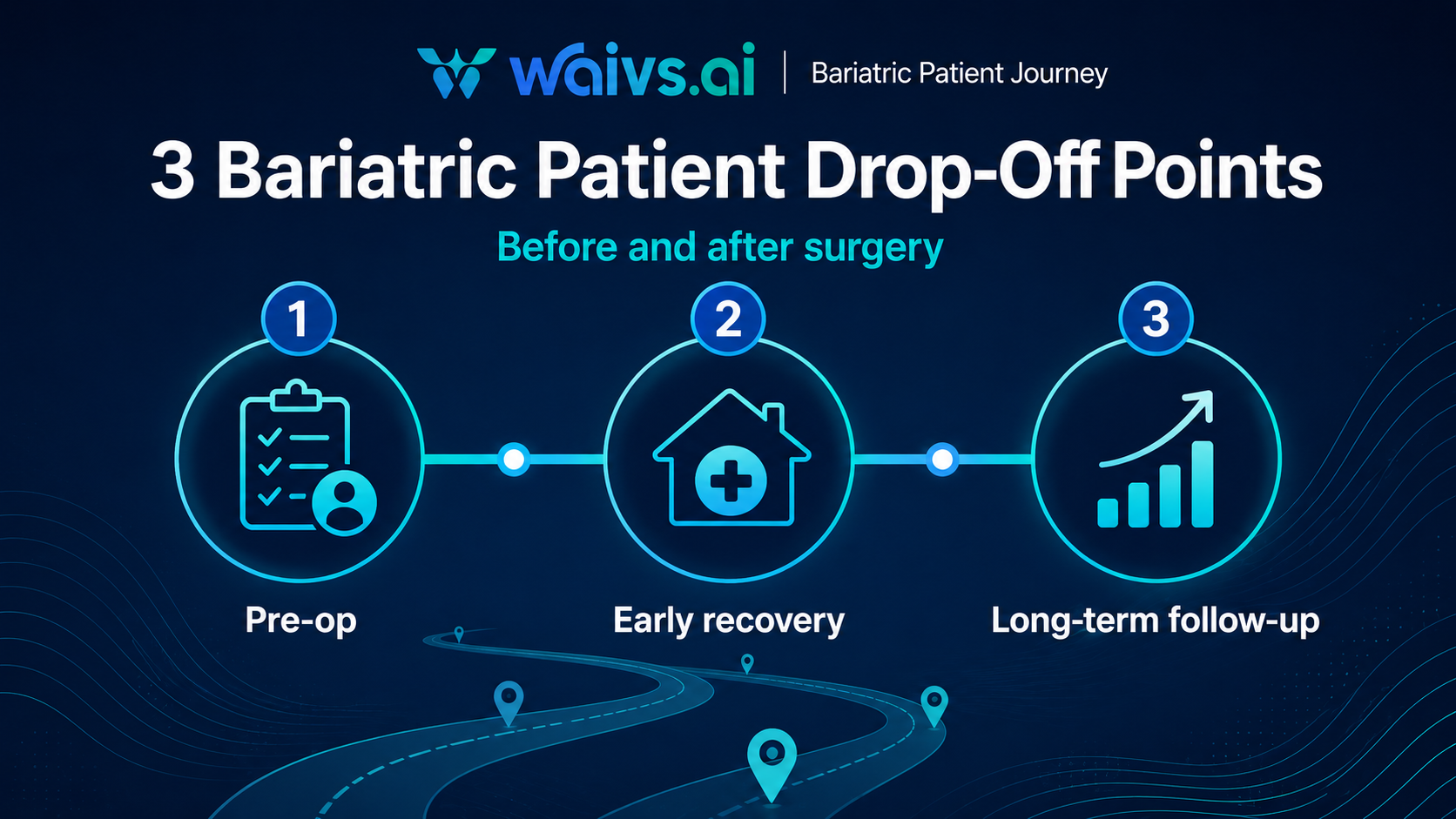
    The more useful question is: where and why do patients lose the confidence to continue on the outlined path? Three points deserve particular attention. 

    1. During preoperative clearance and preparation 

    The preoperative period can involve medical clearance, nutritional education, psychological assessment, testing, insurance requirements and behaviour-change expectations. These are a lot of clinically important steps that can leave a patient feeling physically stalled.When the next step is unclear to them, the pathway can become a series of disconnected tasks rather than one coordinated journey. 

    Signals of pre-op patient drop-off can include an overdue clearance, missed education, repeated rescheduling, an unanswered message or a long period without a meaningful touchpoint. These signals do not prove that the patient intends to leave. They indicate that the program may need a clearer, more consistent method of checking progress and explaining the next step. 

    A strong workflow assigns a purpose to every touchpoint. Instead of sending a generic reminder, the program can reinforce the specific requirement, explain why it matters, identify what is still outstanding and make the route back into the process obvious. 

    2. During the transition from discharge to early recovery 

    The early postoperative period brings a different form of drop-off. Patients are no longer preparing for an event; they are beginning the process of recovery which has no set end-date and is frankly scary. Questions about hydration, diet progression, medications, wound care, nausea, activity and expected symptoms can arrive at any hour and persist constantly in the patients mind. 

    Education is frequently delivered before surgery through classes, printed materials and portals. In a 2025 national survey of bariatric nurses and integrated health professionals, printed materials were used by 95.2% of respondents, while only 62.1% reported evaluating the effectiveness of the knowledge patients acquired. The gap is important: a program can document that education was delivered without knowing whether it stuck with a patient enough for them to apply during recovery. [3] 

    Structured postoperative check-ins create a repeatable opportunity to reinforce approved instructions, collect patient-reported information and identify responses matching predefined escalation criteria. 24/7 availability helps give patients comfort during their most vulnerable periods when a care team may not be available (the middle of the night). The goal is not to replace the care team. It is to make sure routine follow-up happens consistently and that the team can focus attention where review is needed. 

    3. During long-term follow-up 

    Long-term follow-up competes with daily life. The urgency of surgery fades, while ongoing responsibilities such as nutrition, vitamins, laboratory monitoring, appointments, physical activity and chronic-disease management remain. 

    Programs often concentrate their communication resources around preparation and the first weeks after surgery. Long-term touchpoints may become less frequent, less structured and more dependent on the patient initiating contact. That creates a visibility gap: the program may not know whether the patient is doing well, has moved to another provider, is confused about follow-up or has simply stopped responding. 

    Long-term engagement works best when it is planned as part of the pathway rather than added after the fact. Programs can define milestone-based education, periodic check-ins and clear routes back to the team without turning every interaction into a manual coordinator task. 

    Build one connected pathway across all three points 

    The three disengagement points are connected. A patient who experiences confusion during preoperative clearance may enter surgery with unresolved knowledge gaps. A patient who struggles during early recovery may become less likely to remain engaged over the long term. A fragmented communication model makes those transitions harder to see. 

    A useful starting exercise is to map the bariatric journey from referral through long-term follow-up and identify four things at each milestone: what the patient needs to know, what the patient needs to do, what information the program needs back and what conditions require staff review. 

    An AI Surgical Care Companion can support that model by using the customer’s own bariatric protocols, care guides and internal templates. It can deliver approved routine guidance, collect structured responses and identify messages that match predefined escalation criteria. Procedure type, pre-op or post-op stage, days since surgery and previous responses can help provide context. Clinical decisions remain with the bariatric team. 

    A practical first step 

    Choose one transition where the program currently loses visibility—such as an incomplete clearance, a Day 10 postoperative check-in or a missed long-term appointment. Document the current workflow, the approved patient instructions and the conditions that should prompt human review. That single workflow can become the starting point for a more connected patient journey. 

    Sources and further reading 

    1. Caydı S, Anafarta Şendağ M. Barriers to bariatric surgery completion: A narrative review of preoperative attrition and its determinants. Turkish Journal of Surgery. 2026;42(1):26-34. https://pmc.ncbi.nlm.nih.gov/articles/PMC12964095/ 
    1. Groller KD, Curley B, Gourash W. The practice of preoperative patient education in metabolic bariatric surgery: results of a national survey. Surgery for Obesity and Related Diseases. 2025;21(8):971-981. https://www.sciencedirect.com/science/article/pii/S1550728925006847